
By JOHN STOWERS
Oklahoma is nearing six years of a drought that saw some of the hottest and driest conditions on record with Northwest Oklahoma being hit hardest.
Over the summer, Oklahoma experienced several weeks of extreme heat and drought conditions without very much temperature or rain relief to speak of. The extreme conditions combined with their prolonged nature caused detrimental damage to crop yields and livestock numbers. However, this drought did not start this summer, rather starting in late September, 2021. Dean Scarbrough, Professor of Agriculture, and Chair of the Agriculture department, said that he thought the drought might’ve broken in late 2023 or early 2024, but the rainfall amounts from that season we not enough to bring us out of the drought.
“We felt like the drought that we’d been going through in the 2021-22 time period had maybe been broken in the early summer of 2023, but then we’ve just had a couple years where we’ve had intermittent rainfall at different times,” Scarbrough said. “This summer started off well in the early part of the summer and then really got intense as we got the heat and that dry period, so I don’t know if we’ve ever gotten out of the drought completely that’s been going on since 2021 or so.”
A severe but short drought can usually be weathered by most farmers and ranchers, but when a drought this severe goes on for this long, it becomes a gamble for producers on whether or not they will have a successful harvest, or a good breeding season for the herd. If anything goes wrong, like a planted field that doesn’t have enough water and can’t grow anything, or a herd’s primary drinking source dries up and a few of the cows won’t calf or the prize bull of the herd dies from dehydration or a heatstroke, the farmer or rancher is putting his or her entire operation on the line.
“Producers, a lot of the time, can weather short term disruptions, but the longer it goes, the harder it is to effectively manage that,” Scarbrough said. “A drought for any time period can hurt regular production cycles, but the longer it goes on, the more it forces producers to make decisions that may affect their long-term production abilities. My concentration is more on the animal science side, and where we’ve seen things really play out are in — as an example — cow numbers. We’re at the lowest number of beef cattle in the United States in the last 75 years, and it is that progressive drought that we’ve seen that has played a huge role in that.”
Scarbrough also gave an example of why these numbers have gotten so low.
“If you think about a cattle producer that starts to pare down his cow inventory, he starts with older cows, sick cows, cows that haven’t had a consistent breeding history, and then as things continually stay bad with the drought, you start to have to cull your better cows. Once you start to dig that hole, the only way you dig back out of it is to retain heifers and cows to breed, but we’re in a situation where that long term drought has dug us a deep hole.”
Kent Martin, Assistant Professor of Agriculture, explained how an extended drought period affects crop production during and after a drought and that it takes more than a few spring showers to come out of a drought.
“With extended drought you expend essentially all of the moisture, and you get to a point where the amount of moisture is not sustainable for the land and the land-use characteristics,” Martin said. “For example; if I have a yard, or a crop, and there’s not enough rainfall to sustain that crop, then that crop will use all of the available moisture in that soil and you’ll enter drought conditions where the plant is not able to survive. If we have an extended drought, … the amount of rains that we get is not replenishing the moisture in the soil. High-intensity, short-term rainfall events tend to rain faster than the soils can take it in, which then affects moisture movement deep down in the soil profile. Certainly, when you look at rainfall intensity, a long duration of moderate intensity allows for soil intake of water to replenish that in a much deeper zone. When you get into the geology it becomes a little bit more challenging, and when you look at certain areas of the country that depend on aquafer retention and recharge, that’s another dynamic of what the geology allows you to do.”
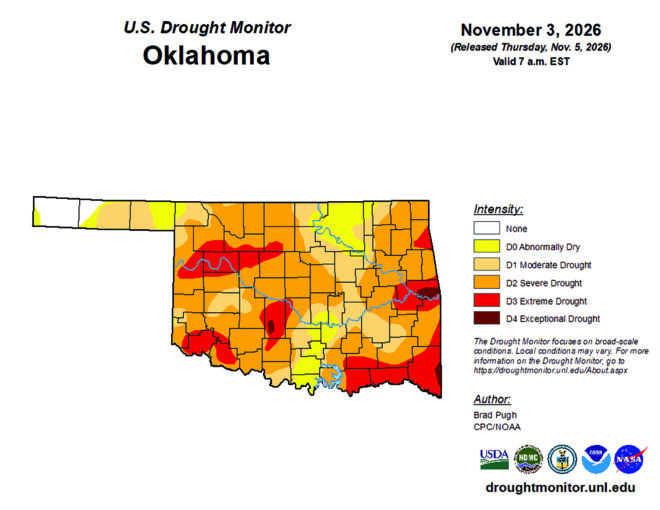
According to the U.S. Drought Monitor, despite the rains that almost pulled Oklahoma out of the drought in late 2023 and early 2024 and the rains that have come into Oklahoma in the latter part of this year, we have been in a drought for almost six years now. As Martin said, that’s because the technical definition that the U.S. Drought Monitor runs off of can sometimes differ with our perception of the effects of a drought.
“When we talk about practical drought, people look more on the short term; are we noticing the effects of a drought on the environment around us,” Martin said. “On the perception of a drought it is ‘did I have decreased crop yields, did I have a brown yard, does the landscape around me look like its burning up and dry’ like we saw this summer. I think part of the challenge that we have is we think about rainfall, but we don’t always think about intensity of rainfall and the amount that has actually done us good. When we have these short-term, high-intensity rainfall events, our perception may be that we’ve had enough rainfall to get us out of a long-term drought, but the reality is that the soil structure, both in the topsoil and subsoil — but then even geologically deeper in the ground — that the ability of the water to move in versus moving off is different. We’ll have moisture movement off of the soil laterally, which is good for us in some ways. If you’re a rancher you’ll say ‘I need moisture runoff because I need ponds to fill and creeks to run so my livestock has water to drink,’ but at the same time we see wells going dry, and wells going dry is an impact of years of drought in the past because we have this gap. Even if we were in a high-rainfall scenario for several years, that gap is still going to be there because of the amount of time it takes for that moisture to get down and replenish that.”
According to the National Oceanic and Atmospheric Administration, there are four types of droughts that currently apply to Oklahoma; meteorological drought, agricultural drought, hydrological drought and ecological drought. A meteorological drought is determined by a lack of precipitation and how conditions like temperature and winds affect moisture levels. It is region-specific and expressed in relation to a region’s average historical conditions. An agricultural drought focuses on precipitation shortages, soil moisture deficits, and evaporative demand, and its severity depends heavily on soil properties, plant types and stages of plant growth. A Hydrological Drought refers to the effects of rain shortfalls on streamflow, groundwater, and reservoir or lake levels. Because it takes longer for precipitation deficiencies to show up in larger hydrological systems, this type of drought is often “lagging” behind other types of droughts. (i.e., the 2003 Pathfinder Reservoir shortage). The type of drought that currently applies most to Oklahoma is an ecological drought, which occurs when prolonged and/or widespread shortages in naturally available water supplies create multiple cascading stresses across ecosystems (i.e., ponds drying up and impacting cattle).
But Kent Martin said farmers and ranchers can get a little bit of a break from the drought every so often, and that they still have a chance to do well even in a drought season.
“In a practical perspective we are always in and out of a drought,” Martin said. “We tend to look at that as a crop cycle or a growing season. You look in your yard and your perspective is things grow from spring to fall, but from an agricultural perspective, we look at the winter crop season and the summer crop season. From a practical standpoint we get … temporary relief from a long-term drought. Seasonally we may get a temporary relief like the summer crop season of 2024 and 2025 that were really good, but then there was the summer crop season of 2026 that really was not very good. … I had grain sorghum planted this summer. I had two fields with a planting date separated by about a week and a half. The flowering dates of those two fields were obviously differed. Because we had one rain that came around the time of flowering, and because of where one of those fields was in maturity versus the other, it made a 20-bushel difference in yield because it hinged upon that one rain giving us a very very short-term relief when flowering occurred. It’s an example of how even in the intensity of a drought as intense as we were this summer, one little rain made a huge difference because of the timing.”